

Our team got thoroughly drenched on Sunday 6th September but it was all for a good cause – raising money…
Awarding a contract to the lowest bidder feels responsible. But in signage procurement, the cheapest quote often becomes the most expensive decision you ever make.
Every year, businesses, local authorities, developers and facilities managers across the UK commission signage projects – wayfinding systems, building identification, health and safety signage, digital displays – and make the same mistake.
“They compare quotes on price alone, choose the lowest number, and find themselves paying far more than they anticipated before the project is complete, or long after it is.” Ruth, Astley’s Procurement Manager
The confusion between price and cost is one of the most persistent errors in procurement.
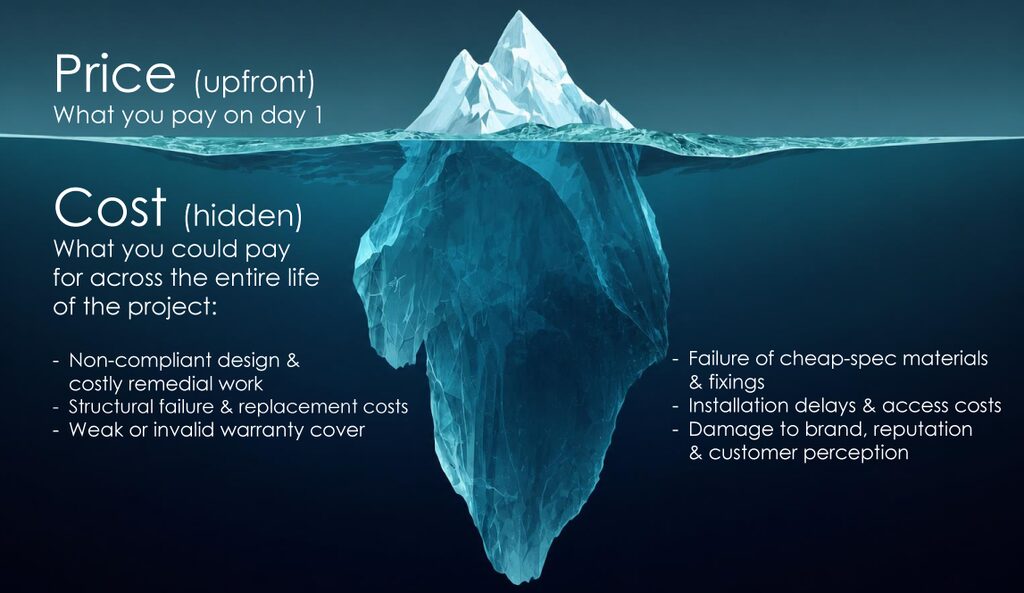
Price is...– what appears on the quotation / – what you pay on day one
Cost is...– everything you spend across the entire lifespan of the signage, including the things nobody quoted you for
The quotation is only the beginning
When you receive a quote for a signage project, you are typically seeing the cost of materials and labour to manufacture and install a defined scope of work at a point in time. What you are rarely seeing is the full picture.
Consider what a low-cost supplier might not be pricing in:
- Compliant substrate materials that hold colour and structural integrity outdoors in UK weather conditions
- Fixings that won’t corrode on a coastal or urban site
- A design process that properly accounts for the BS 8300 accessibility standards or PAS 127 wayfinding guidance
- An installation methodology that avoids damage to a listed building’s fabric
- A warranty backed by a business that will still be trading in three years.
A signage system that fails early, fades within two years, or requires a planning enforcement notice to be removed will cost you far more than the premium you avoided paying at the outset.
Where the real costs live
The total cost of signage ownership spans four distinct phases. Each carries hidden expenditure that a low initial price will rarely protect you from.
- Design Inadequate design leads to reprints, planning rejections, and accessible design failures requiring remediation.
- Manufacture Poor substrates, inks, and finishes degrade faster — especially in UK weather. Replacement costs accumulate quickly.
- Installation Incorrect fixing methods, damaged surfaces, and failed inspections mean remedial work at the buyer’s expense.
- Maintenance A system with no ongoing support contract will cost more in reactive callouts than a planned maintenance schedule ever would.
The design stage: false economy starts here
Signage design is not a commodity.
A thorough design process involves:
- Site surveys
- Stakeholder consultation
- Accessibility audits
- Planning assessments (particularly for listed buildings or conservation areas where deemed consent does not apply)
- Production of detailed manufacturing drawings.
Cut corners here and you pay later – through reprints, planning appeals, or signage that simply does not work for the people who need to use it.
Under the Equality Act 2010, organisations have a duty to make reasonable adjustments. Signage that fails on legibility, contrast, tactile provision, or mounting height is not a minor aesthetic issue – it is a legal exposure. A cheap design service that doesn’t know BS 8300 is a liability dressed as a saving.
Manufacture: what you can’t see will cost you
Two signs can look identical on a sample board but behave very differently over five years.
UV-stable inks, weatherproof substrates, marine-grade fixings, and powder-coat finishes with appropriate corrosion ratings all carry a cost premium for good reason. The UK climate — wind-driven rain, UV exposure in summer, freeze-thaw cycles — is genuinely demanding on exterior signage.
A low-cost manufacturer may substitute materials without disclosure: a cheaper aluminium alloy, a standard rather than UV-rated vinyl, mild steel fixings where stainless is specified. You may not notice for 18 months. By which point your supplier may be hard to reach, and the rectification cost is entirely yours.
“The bitterness of poor quality remains long after the sweetness of low price is forgotten.”
Benjamin Franklin
Installation: the moment everything becomes real
Installation is where under-priced projects most visibly unravel.
A signage contractor who has cut their margin to win the job may be working with less experienced installers, inadequate equipment, or a programme that doesn’t allow for the access arrangements your site genuinely requires.
On a heritage building, incorrect drilling or fixing methods can cause damage that costs multiples of the signage itself to remediate. On a construction or live retail site, an installer without the right CSCS cards, IPAF certification, or public liability cover creates a risk that falls back on the building owner or principal contractor.
The cheapest installation quote is often the one that hasn’t properly priced the job.
Maintenance: the cost that nobody budgets for
Most organisations commission signage and give no thought to its maintenance – until something breaks, fades, or becomes illegible and they need it fixed urgently. Reactive maintenance is almost always more expensive than planned maintenance. A reactive callout for a single illuminated sign head replacement, including access equipment, can cost more than an annual maintenance contract covering your entire estate.
“Reactive maintenance when something fails or wasn’t built for purpose will almost always be more expensive that planned maintenance.”
The better signage suppliers offer planned preventative maintenance agreements: periodic inspections, cleaning, lamp or LED replacement, vinyl refresh on a cycle – all at a known, budgeted cost. Buyers who choose on price alone often end up without this option, or with a supplier who lacks the geographic reach and resource to deliver it reliably.
What to ask instead of “what’s your lowest price?”
- What materials are specified, and what are their warranted lifespans in exterior UK conditions?
- Does the design fee include a BS 8300 accessibility review and planning compliance check?
- What certifications do your installation teams hold — CSCS, IPAF, PASMA?
- What does your warranty cover, and for how long? What is your response time for defects?
- Do you offer a planned maintenance programme, and what does it include?
- Can you provide references from clients whose signage you installed and still maintain?
- What is your process if materials are unavailable and substitutions are required?
The invisible cost of damage to your brand
How do you quantify the damage to your brand when your signage fails?
It’s not just the downtime while you wait to get it illuminated again. It’s not the inconvenience caused to customers and site staff while maintenance teams are on site carrying out repairs. And it’s not simply the cost of replacing the sign.
The real cost can be far less visible — and far more damaging.
It’s the impact on reputation and perception.
Because if your signage is failing, what does that say about the reliability of the product or service you’re selling? Customers don’t necessarily separate the sign from the brand behind it. What they see becomes part of what they believe.
A dark, damaged or unreliable sign can create an unintended message:
If they can’t keep their own brand presentation working, how reliable are they when it comes to looking after me?
There aren’t many better demonstrations of the old adage:
Perception is reality.
“Your signage is more than a wayfinding tool or a logo on a building. It’s a highly visible representation of your brand – often the first thing customers see and one of the last things they see when they leave. So when it fails, the question shouldn’t simply be how much will it cost to fix…it should be what is the cost to our brand while it remains broken!”
Procure for value, not for price
The public sector has long understood this distinction — the concept of Most Economically Advantageous Tender (MEAT), now framed as Most Advantageous Tender (MAT) under the Procurement Act 2023, exists precisely because price alone is a poor proxy for value. Private sector buyers should potentially also apply the same thinking.
When you evaluate signage proposals, weight the criteria that reflect whole-life cost: quality of materials, depth of the design process, installation competence, warranty terms, maintenance capability, and the supplier’s track record.
“A 10% premium at quotation stage that eliminates a replacement programme in year three, a planning enforcement action or an accessibility complaint is not a cost – it is a saving.
Price is what you pay on day one. Cost is what you pay across the entire life of the project. They are rarely the same number, and the gap between them is where good procurement decisions are made.